D’var Torah Parashat “Vayeira” - “And He Appeared”
The Test Of Faith. The Courage To Act.
When conviction is tested, responsibility is revealed
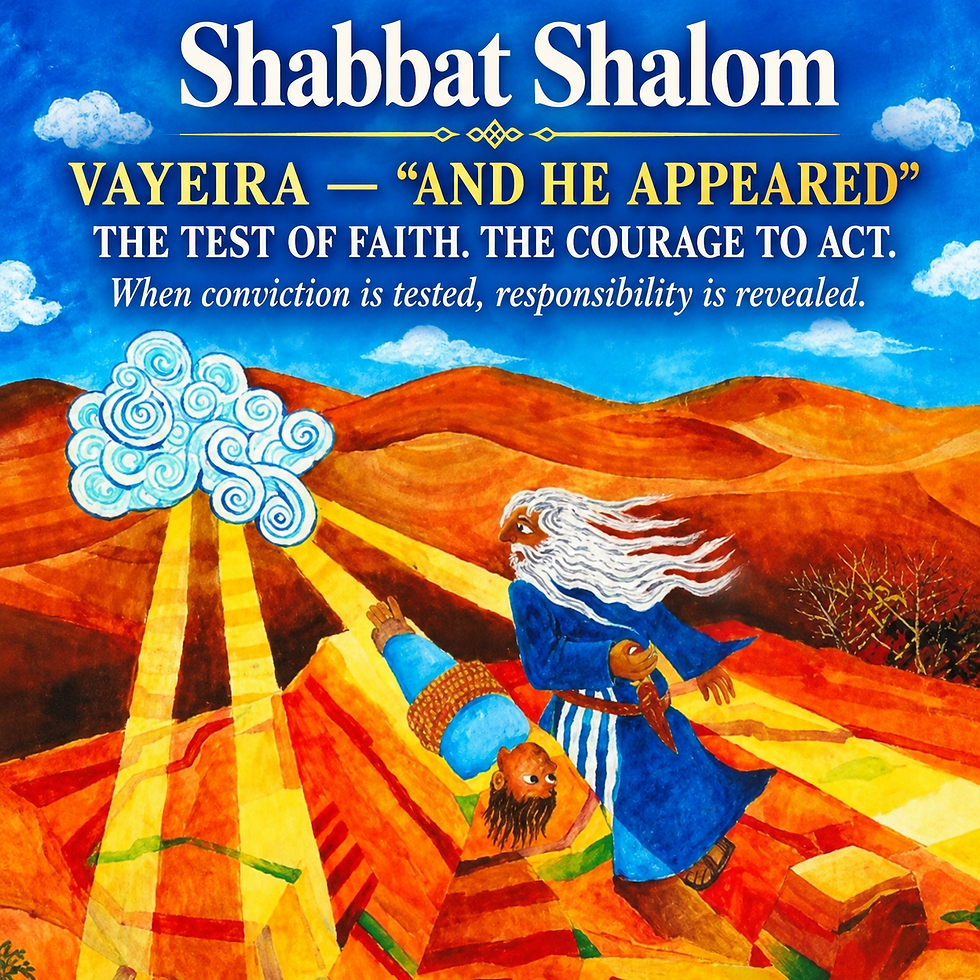
TGFIF WEEKLY D’VAR TORAH
D’var Torah “Vayeira” “And He Appeared” Genesis 18:1–22:24
The Test Of Faith. The Courage To Act.
When conviction is tested, responsibility is revealed.
וַיֵּרָא אֵלָיו יְהוָה
“And the LORD appeared to him.” - Genesis 18:1
WHEN FAITH IS PUT TO THE TEST
Four weeks. Four lessons. One unfolding responsibility.
BERESHIT - BEGIN AGAIN.
NOACH - BUILD THE ARK.
LECH-LECHA - GO FORTH.
VAYEIRA - RISE TO THE TEST.
In Bereshit, G-d creates the world and entrusts humanity with responsibility.
In Noach, one man is called to preserve life amid a world overwhelmed by corruption.
In Lech-Lecha, Abraham leaves the familiar to begin a covenantal journey.
Now, in Vayeira, that covenant is tested.
Abraham has answered G-d's call. He has accepted the covenant and committed himself to a life of faith.
But commitment is only the beginning.
Faith must be demonstrated when compassion is inconvenient, justice is difficult, obedience is demanding, and the future appears uncertain.
The Torah does not present Abraham as a man whose faith eliminates adversity. It presents him as a man whose faith is revealed through adversity.
Our world faces its own tests.
Israel confronts political uncertainty. Americans approach consequential midterm elections. Hezbollah reportedly rebuilds military capabilities while diplomatic arrangements promise stability. Across Europe, unrest and debates over immigration, integration, and civic identity challenge governments and citizens alike.
Different nations. Different circumstances.
One fundamental question:
What happens when the principles we proclaim are tested by the realities we confront?
THIS WEEK AT A GLANCE
ISRAEL - THE TEST OF NATIONAL UNITY
Israel faces political uncertainty and competing visions of leadership as the nation confronts continuing security and social challenges. The responsibility to preserve democratic legitimacy and national unity remains paramount.
UNITED STATES - THE TEST OF DEMOCRACY
As Americans approach the midterm elections, decisions about leadership, national priorities, and the balance of power carry consequences extending well beyond a single election cycle.
LEBANON - PHONY PEACE
Diplomatic arrangements offer the promise of stability, yet reports indicate that Hezbollah is rebuilding military capabilities with Iranian support.
A ceasefire that permits an enemy to rearm may become an intermission between wars rather than a pathway to peace.
Diplomacy can save lives. But its success must be judged by verifiable commitments, enforceable security arrangements, and meaningful accountability.
The absence of gunfire is not necessarily the presence of peace.
EUROPE - THE TEST OF CIVILIZATION
Civil unrest and political disputes across Europe have intensified debates about governance, economic pressures, immigration, integration, and the rule of law.
These developments have different causes and should not be treated as a single phenomenon. Together, however, they raise enduring questions about the principles free societies must preserve.
Will we uphold our values when doing so becomes difficult?
THE TORAH - FIVE TESTS OF FAITH
Vayeira opens with G-d appearing to Abraham near the oaks of Mamre.
Abraham is recovering from the circumcision commanded at the conclusion of Lech-Lecha.
The covenant has been marked upon his body.
Now its obligations are revealed through his actions.
The parsha moves from Abraham's hospitality toward three visitors to his plea for Sodom, the destruction of the cities and Lot's family's escape, the miraculous birth of Isaac, and finally the Akedat Yitzchak - the binding of Isaac.
Together, these episodes reveal the responsibilities of a covenantal life.
1. THE THREE ANGELS - THE TEST OF COMPASSION
וַיָּרָץ לִקְרָאתָם
“And he ran to meet them.” - Genesis 18:2
Three travelers approach Abraham's tent.
He does not wait for them to request assistance.
He runs to greet them, offering water, food, and rest.
Abraham is recovering from circumcision. Yet his discomfort does not prevent him from responding to the needs of others.
Unknown to Abraham, the visitors are angels, but he welcomes them as travelers in need.
This sequence is significant.
Circumcision marked Abraham's covenant upon his body.
Hospitality revealed that covenant through his actions.
The sign of faith is what we carry. The proof of faith is what we do.
The lesson remains relevant as European societies confront questions about immigration, integration, national identity, and the responsibilities of citizenship.
Abraham's hospitality establishes a moral obligation toward the stranger. It does not require a society to abandon its laws or the principles upon which its freedoms depend.
A nation can welcome newcomers while expecting all residents, native-born and newly arrived, to respect its laws and institutions.
Compassion without accountability is incomplete.
Accountability without compassion is equally deficient.
A civilization must know both whom it welcomes and what principles it refuses to surrender.
The test of compassion is whether we recognize another person's humanity without surrendering our responsibility to protect the wider community.
2. SODOM AND GOMORRAH - WHEN CORRUPTION BECOMES A WAY OF LIFE
הֲשֹׁפֵט כָּל־הָאָרֶץ לֹא יַעֲשֶׂה מִשְׁפָּט
“Shall the Judge of all the earth not do justice?” - Genesis 18:25
The destruction of Sodom and Gomorrah is among the Torah's most sobering accounts of moral collapse.
These were not cities condemned for a single transgression.
Their wickedness had become embedded in the character of their societies.
Violence, cruelty, and the rejection of basic moral obligations had become pervasive.
Yet Abraham does something extraordinary.
He challenges G-d.
Will the innocent perish alongside the guilty?
What if fifty righteous people can be found?
Forty-five?
Forty?
Thirty?
Twenty?
Ten?
Abraham pleads for mercy, seeking even a small righteous presence that might spare the cities.
But the cities are not spared.
The greatest danger to a civilization is not the existence of evil, but the normalization of it.
Every society confronts wrongdoing.
The critical distinction is whether its institutions recognize wrongdoing and possess the courage to confront it, or whether corruption becomes accepted as part of the social order.
When violence is excused, justice becomes selective, cruelty is tolerated, and institutions cease protecting the innocent, a society begins undermining its own foundations.
Sodom presents the terrifying possibility that moral corruption can become so entrenched that a civilization loses the foundations necessary for its preservation.
Yet Abraham's response is as important as the cities' fate.
He does not seek indiscriminate destruction.
He seeks justice.
He insists that the innocent must be distinguished from the guilty.
That righteousness must matter.
That human life must matter.
The Torah does not authorize us to declare modern nations beyond salvation simply because they face unrest, corruption, or political disagreement.
It challenges us instead to confront moral decay before it becomes normalized.
Free societies must enforce their laws fairly, reject political violence, defend the innocent, and preserve the principles that sustain liberty.
The test of civilization is not whether corruption exists. It is whether society still possesses the moral courage and institutional strength to confront it.
3. LOT'S WIFE - THE TEST OF OBEDIENCE
אַל־תַּבִּיט אַחֲרֶיךָ
“Do not look behind you.” - Genesis 19:17
Lot and his family are commanded by the angelic messengers to flee Sodom.
The danger is unmistakable.
The instruction is explicit.
Do not look back.
Yet Lot's wife disobeys.
וַתַּבֵּט אִשְׁתּוֹ מֵאַחֲרָיו
“But his wife looked back.” - Genesis 19:26
She becomes a pillar of salt.
The Torah does not explain precisely why she looked back. Jewish commentators have offered different interpretations.
But the narrative establishes that a clear command had been given and was disregarded.
Lot's wife was not asked to understand every consequence of the destruction unfolding behind her.
She was commanded to leave and not look back.
Yet she looked back.
The lesson is not that every human instruction deserves unquestioning obedience.
It is that a divine command, clearly given in the biblical narrative, demanded a response.
The warning was clear. The command was explicit. The consequence was irreversible.
For the Jewish people, memory remains sacred. We are commanded to remember our history, including its most painful chapters.
But remembrance must inform our actions rather than prevent us from recognizing the responsibilities of the present.
Memory must guide us forward, not become an excuse for failing to act.
The test of obedience is whether we respond to a clear moral obligation even when doing so requires us to leave behind what is familiar.
4. THE BIRTH OF ISAAC - THE TEST OF HOPE AND CONTINUITY
וַיהוָה פָּקַד אֶת־שָׂרָה כַּאֲשֶׁר אָמָר
“And the LORD remembered Sarah as He had said.” - Genesis 21:1
Abraham is 100 years old.
Sarah is 90.
The promise of a child appears impossible by every ordinary human measure.
Yet Isaac is born.
His name, Yitzchak, is connected to laughter.
What once seemed beyond possibility becomes the beginning of a new generation.
The significance of Isaac's birth extends beyond the joy of his parents.
It represents continuity.
The greatest reward promised to Abraham was not wealth, power, or personal comfort.
It was continuity.
A son.
A people.
A future.
Abraham would not live to see the full realization of the covenantal promise. But he accepted responsibility for building what future generations would inherit.
For the Jewish people, this lesson resonates across centuries of exile, persecution, expulsion, pogroms, the Holocaust, war, and terrorism.
Despite extraordinary suffering, Jewish communities rebuilt, Jewish learning endured, and
Jewish sovereignty was reestablished in our ancestral homeland.
Isaac's birth does not promise that every act of faith will produce a miracle.
It teaches that present circumstances do not always determine the future.
But hope is not a guarantee.
And hope is not passivity.
A future worth believing in is also a future worth building.
We must invest in Jewish education, strengthen our institutions, support Israel, and develop the next generation of leaders.
Our responsibility is not merely to preserve what we inherited.
It is to ensure that the next generation receives something stronger.
The test of hope is whether we invest in a future we may never personally witness.
5. AKEDAT YITZCHAK - THE ULTIMATE TEST OF FAITH
וְהָאֱלֹהִים נִסָּה אֶת־אַבְרָהָם
“And G-d tested Abraham.” - Genesis 22:1
The Torah now brings us to one of its most difficult and profound passages.
Abraham is commanded to take Isaac, the son through whom the covenant has been promised, and offer him as a sacrifice.
The tension is extraordinary.
How can the child who represents the future become the subject of such a command?
How can Abraham reconcile the promise of continuity with the apparent demand for its destruction?
And how can we understand the same Abraham who pleaded for the innocent at Sodom now proceeding without a recorded objection?
At Sodom, Abraham questioned.
At the Akedah, Abraham obeyed.
These are among the most profound challenges presented by the biblical narrative.
Jewish commentators have wrestled with their meaning for generations.
The Torah does not offer an easy answer.
Abraham proceeds toward Mount Moriah.
Isaac accompanies him.
At the decisive moment, an angel calls out:
אַל־תִּשְׁלַח יָדְךָ אֶל־הַנַּעַר
“Do not raise your hand against the boy.” - Genesis 22:12
Isaac is spared.
A ram is offered instead.
The Akedah is traditionally understood as an extraordinary test of Abraham's faith.
But the angel's intervention is essential.
The command to stop is as real as the command that began the test.
And the life of Isaac, the future of the covenant, is preserved.
Consider the contrast.
At Sodom, Abraham asked G-d to spare lives.
At the Akedah, Abraham was commanded to offer the life through which his covenantal future had been promised.
At Sodom, he questioned.
At the Akedah, he obeyed.
Yet both narratives ultimately preserve a fundamental truth: human life is not insignificant.
At Sodom, Abraham demanded that the innocent be distinguished from the guilty.
At the Akedah, the angel intervened before Isaac could be harmed.
Faith does not relieve us of moral responsibility. It makes that responsibility more profound.
The Akedah is not an instruction for us to imitate Abraham's ordeal. It is a sacred narrative that challenges us to examine faith, obedience, moral judgment, and the sanctity of life.
These questions carry particular weight in our own time.
We ask soldiers to defend their countries, citizens to accept civic responsibilities, and leaders to make difficult decisions whose consequences may extend across generations.
But sacrifice must never become an abstraction.
Behind every fallen soldier is a family.
Behind every act of terrorism is a human life.
Behind every decision to pursue war or peace are people who must live with the consequences.
Faith demands courage.
Leadership demands judgment.
Responsibility demands that we never lose sight of the lives entrusted to our care.
The ultimate test is not simply whether we are willing to sacrifice. It is whether we understand what we are responsible for preserving.
WE REMEMBER - THREE YEARS AFTER OCTOBER 7
Three years after October 7, 2023, we remember those murdered in their homes and communities, those murdered at the Nova music festival, those taken hostage, the wounded, and the families whose lives were forever changed.
We remember the soldiers who have fallen defending Israel and the families who continue to carry the burden of loss.
Remembrance is not passive.
To remember is to preserve the truth.
To honor is to defend the dignity of those whose lives were taken.
To act is to ensure that remembrance produces something meaningful for those who follow.
NEVER FORGET.
NEVER DO NOTHING.
TURN WORDS INTO DEEDS.
FINAL TAKEAWAY - RISE TO THE TEST
Four weeks.
Four lessons.
BERESHIT - BEGIN AGAIN.
NOACH - BUILD THE ARK.
LECH-LECHA - GO FORTH.
VAYEIRA - RISE TO THE TEST.
Abraham's faith was not revealed in a single moment.
It was tested through compassion, justice, obedience, hope, and sacrifice.
Our tests arrive in different forms.
Through elections that determine the direction of nations.
Through ceasefires that promise peace while threats remain.
Through societies struggling to preserve the principles upon which their freedoms depend.
Through the responsibility to protect the next generation.
We do not claim to know G-d's purposes in the events of our time.
But we know that our response matters.
Faith is what we believe. Character is what we do when that belief is tested.
May Hashem protect the people of Israel and the courageous men and women of the IDF and the United States Military.
May He comfort the families of the fallen, heal the wounded, and protect the innocent.
May He grant wisdom to the leaders of Israel, the United States, and all nations confronting difficult choices.
May He guide us toward genuine peace grounded in justice, security, and accountability.
And may He give us the courage to rise to the tests before us, transforming faith into action, responsibility into service, and the promises of our inheritance into a future worthy of those who came before us.
VAYEIRA. AND HE APPEARED.
RISE TO THE TEST.
NEVER FORGET. NEVER DO NOTHING. TURN WORDS INTO DEEDS.
Shabbat Shalom. Am Yisrael Chai. 💙✡️🇮🇱✡️💙


Comments