D’Var Torah: Parashat "Ki Tavo" “When You Come” - Day 1,056 "When You Come, Know What You Have Built"
Updated: 2 days ago

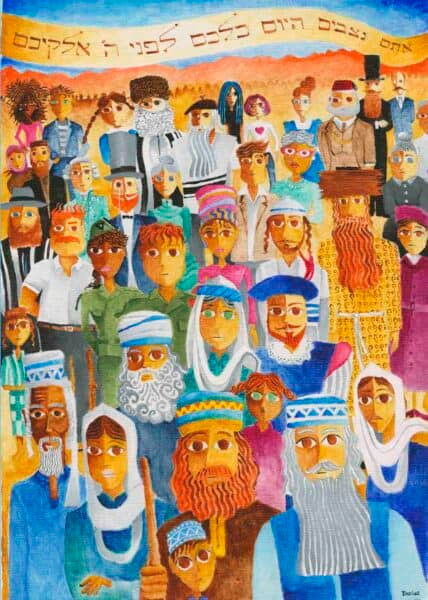
Artwork by: Darius Gilmont
Parashat Ki Tavo - “When You Come” - Day 1,056
When You Go Out – Know What You Have Built
וְהָיָה כִּי־תָבוֹא אֶל־הָאָרֶץ
“And it shall be, when you come into the land…” - Deuteronomy 26:1
Parashat Ki Tavo reminds us that entering the land is only the beginning; what matters is how we remember, give thanks, and steward what has been entrusted to us.
OPENING
As we welcome Shabbos, it is Day 1,056 since the atrocities of October 7. Around Israel, the language of peace is everywhere. Ceasefires. Frameworks. Negotiations. Disarmament plans. International guarantees.
Yet the distance between the words describing peace and the conditions required for peace remains enormous.
In Gaza, Hamas has agreed to a framework involving the decommissioning of its weapons, yet actual implementation remains unresolved. In Lebanon, Hezbollah remains armed. Israel continues to tie withdrawal to Hezbollah’s disarmament. And six months into the confrontation with Iran, there is still no durable settlement. Military pressure has increasingly been joined by economic pressure as the United States attempts to further restrict the resources available to Tehran.
There are agreements. There are announcements. There are negotiations.
But each new ceasefire risks becoming little more than words if the conditions that produced the war remain unchanged.
Phony Peace. Kabuki Theater.
The world announces progress. Reality waits.
And then the Torah speaks:
כִּי־תָבוֹא – “Ki Tavo” – “When you come”
Last week:
Ki Teitzei - When you go out.
This week:
Ki Tavo - When you come.
Going out requires courage.
Coming home requires an accounting.
What changed? What did the struggle produce? And when we finally arrive, What will we find?
THIS WEEK AT A GLANCE
ISRAEL • GAZA • LEBANON
PHONY PEACE • KABUKI THEATER
Ceasefires are announced. Frameworks are negotiated. Diplomats declare progress.
Yet Hamas’s disarmament remains unresolved. Hezbollah remains armed. Military operations continue.
The details change. The underlying question does not:
Did reality change - or only the language describing it?
Diplomacy matters. Negotiation matters. Peace must always be pursued. But a promise to disarm is not disarmament. A framework without implementation is paper. A ceasefire without changed intentions may be little more than an intermission.
STOP THE BLEED
A ceasefire can stop the bleeding. It cannot cure the disease. When the underlying conditions remain unchanged, diplomacy risks becoming Kabuki Theater and peace becomes Phony Peace.
IRAN
Economic pressure on Iran continues to increase. Washington has intensified sanctions and financial pressure while Tehran searches for ways to preserve trade networks, maintain regime resources and blunt the impact of growing isolation. Economic pressure appears to be taking an increasing toll on Iran’s already strained economy, even as the regime and the IRGC insist they can withstand it. Whether that pressure ultimately changes Tehran’s calculations remains to be seen.
But the question is not whether Iran can sign another agreement. Iran has signed agreements before.
The question is:
What changes afterward?
AMERICA
America faces its own questions of stewardship.
Different battlefield. Same question:
When the struggle is over, what kind of country are we trying to preserve?
Which leaves us with the question hanging over the entire week:
Are we moving toward resolution - or simply performing around the problem?
BRIDGE TO THE TORAH
Ki Tavo begins:
וְהָיָה כִּי־תָבוֹא אֶל־הָאָרֶץ אֲשֶׁר יְהוָה אֱלֹהֶיךָ נֹתֵן לְךָ נַחֲלָה
“And it shall be, when you come into the land that Hashem your God gives you as an inheritance…” - Deuteronomy 26:1
Notice what the Torah does not say.
It does not end the story with arrival.
Entering the Land is not the conclusion.
It is the beginning of responsibility.
The Israelite must bring the first fruits.
He must remember where he came from.
אֲרַמִּי אֹבֵד אָבִי
“An Aramean sought to destroy my father…” - Deuteronomy 26:5
He must recount the story of his people:
וְהָיָה כִּי־תָבוֹא אֶל־הָאָרֶץ אֲשֶׁר יְהוָה אֱלֹהֶיךָ נֹתֵן לְךָ נַחֲלָה
“And it shall be, when you come into the land that Hashem your God gives you as an inheritance…” - Deuteronomy 26:1
He must acknowledge Who made his prosperity possible.
He must tithe.
He must remember the Levite, the stranger, the orphan and the widow.
Israel must accept the covenant.
And then the Torah presents blessings and curses.
Peace does not require us to forget how war began.
Reconciliation does not require us to rewrite history.
Arrival must never become amnesia.
Prosperity does not eliminate obligation.
Arrival increases responsibility.
Last week, Ki Teitzei asked:
When you go out, do you remember what you are defending?
Ki Tavo asks what must eventually follow:
When you come - what have you built?
And perhaps more importantly:
What have you become?
TORAH LESSONS FOR TODAY
1. PEACE MUST EXIST IN REALITY
Ki Tavo begins not with a promise of arrival. It begins with arrival itself.
“When you come into the land…”
You are there.
Reality has arrived.
Our diplomacy must ultimately be judged the same way. A ceasefire announcement is not peace. A promise to disarm is not disarmament.
A memorandum is not compliance. A handshake is not reconciliation.
Diplomacy matters. Negotiation matters.
Every genuine opportunity for peace should be pursued. Every unnecessary death avoided.
But peace cannot be performed into existence.
The cameras can capture the handshake. The communiqué can declare progress. The diplomats can congratulate one another.
But if the weapons remain, If the ideology remains, If the intention remains,
Then the conditions for the next war remain.
The test of peace is not what was signed. The test is what changed.
2. BLESSING REQUIRES RESPONSIBILITY - AND MEMORY
One of the first commandments Israel receives upon entering the Land is remarkably simple: Bring the first fruits.
The farmer takes the first of what he has produced and brings it before Hashem. But he does more than bring fruit.
He tells a story.
“An Aramean sought to destroy my father…”
He remembers vulnerability. He remembers Egypt. He remembers suffering. He remembers redemption. He remembers how he arrived.
The Torah teaches something profound:
Arrival must never become amnesia.
Peace does not require us to forget how war began.
Reconciliation does not require rewriting history.
Prosperity does not permit us to forget the sacrifices that made prosperity possible.
Then comes the tithe.
What we receive creates obligations beyond ourselves - to the Levite, the stranger, the orphan and the widow.
And then Ki Tavo speaks about Israel itself. Hashem has affirmed Israel as His treasured people.
The Jewish people are chosen. But chosenness is not a trophy. It is a trust.
It does not mean fewer obligations. It means more.
More responsibility to pursue justice. More responsibility to protect the vulnerable. More responsibility to remember. More responsibility to distinguish right from wrong. More responsibility to remain who we are when doing so becomes difficult.
Freedom is a blessing. Prosperity is a blessing. Strength is a blessing. But every blessing creates responsibility.
Privilege without responsibility eventually becomes entitlement.
And entitlement without memory eventually forgets where the blessing came from.
3. MORAL INVERSION - DO NOT CALL THE CURSE A BLESSING
Ki Tavo contains some of the Torah’s most extraordinary blessings.
And some of its most terrifying curses.
The “Tochacha” - the “Rebuke” is difficult to read.
Security can become fear.
Prosperity can become deprivation.
Strength can become vulnerability.
Blessing can become curse.
The Torah’s blessings and curses insist upon something our age increasingly resists:
There is a difference between right and wrong.
Between fidelity and betrayal.
Between blessing and curse.
They do not become interchangeable merely because circumstances - or politics -make the distinction inconvenient.
Choices matter. Conduct matters. Truth matters.
And Moral Inversion begins when a society loses the willingness to distinguish between the choices that produce blessing and those that produce curse.
Terrorism becomes “resistance.”
Antisemitism becomes “anti-Zionism.”
Intimidation becomes “protest.”
Extremism becomes “activism.”
Self-defense becomes “aggression.”
And eventually
The curse is called a blessing. And the blessing is called a curse.
But moral standards must work in both directions.
Not every criticism of Israel is antisemitism.
Not every Muslim is an Islamist.
Not every progressive is a Marxist.
Not every political opponent is an enemy.
The Torah requires distinctions.
Intent matters. Conduct matters. Truth matters.
The moral standard cannot change simply because changing it benefits our side.
Confront evil without surrendering moral clarity.
Because a society that can no longer distinguish blessing from curse, eventually loses both.
THE HEBREW WORD OF THE WEEK
כִּי־תָבוֹא – “KI TAVO” - “WHEN YOU COME”
There is an important difference between leaving and arriving.
Leaving asks: What are you prepared to fight for?
Arriving asks: What did the struggle produce?
Ki Teitzei demanded courage. Ki Tavo demands accountability.
When you come - Look around.
Do not judge the journey by the promises made along the way.
Do not judge peace by the announcement.
Do not judge diplomacy by the ceremony.
Do not judge success by the applause.
Judge it by where you actually arrived.
STEWARDSHIP INSIGHT- WHAT WE RECEIVE, WE HOLD IN TRUST
The first fruits are stewardship.
The tithe is stewardship.
The Land is stewardship.
Freedom is stewardship.
Israel is stewardship.
America is stewardship.
We inherit things we did not create.
We enjoy sacrifices we did not make.
We stand on foundations laid by people whose names we may never know.
Previous generations handed these things to us.
Now they are temporarily ours.
That is stewardship.
The question is not merely: What did we receive?
The question is: What condition will it be in when we hand it forward?
The Torah does not permit us merely to consume our inheritance.
It asks us to preserve it. Strengthen it. Improve it.
And eventually - Pass it on.
FINAL TAKEAWAY
Ki Teitzei taught us how to go out.
Ki Tavo teaches us how to come home.
Come home with memory.
Come home with gratitude.
Come home with responsibility.
Pursue peace.
Stop the bleeding whenever we can.
But never confuse peace with its performance.
Never confuse promises with changed reality.
Never allow Moral Inversion to turn blessing into curse - or curse into blessing.
כִּי־תָבוֹא – “KI TAVO” “When you come”
Remember where you came from.
Remember who you are.
Remember what was entrusted to you.
And when you look at the world you are preparing to hand forward,
KNOW WHAT YOU HAVE BUILT.
May Hashem protect the people of Israel.
May He guard the courageous men and women of the IDF and the United States Military.
May He bring healing to the wounded, comfort to the grieving, and freedom to the captives.
May He strengthen those who stand on the front lines of freedom and civilization.
צֶדֶק צֶדֶק תִּרְדֹּף Justice. Justice shall you pursue.
Shabbat Shalom, Am Yisrael Chai! 💙🇮🇱💙🇮🇱💙


Comments