D’Var Torah: Parashat “Nitzavim–Vayelech” - “Standing • And He Went” - Day 1,063
Updated: 2 days ago
STAND TOGETHER - THEN CHOOSE LIFE

TGFIF WEEKLY D’VAR TORAH
Parashat “Nitzavim–Vayelech” - “Standing • And He Went” - Day 1,063
STAND TOGETHER - THEN CHOOSE LIFE
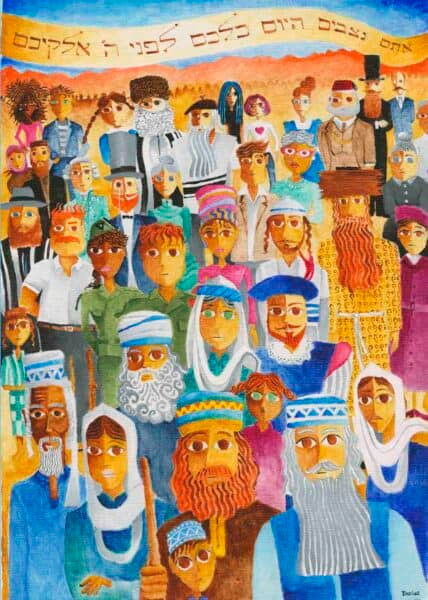
אַתֶּם נִצָּבִים הַיּוֹם כֻּלְּכֶם
“You are standing today, all of you…” - Deuteronomy 29:9
OPENING
As we welcome Shabbos, it is Day 1,063 since the atrocities of October 7. The fighting is escalating again. In Iran, renewed fighting has shattered the illusion that periods of relative quiet necessarily mean resolution. In Lebanon, Israel continues to confront Hezbollah and the infrastructure built to threaten Israel from its northern border.
Last week we asked whether the language of peace was being matched by reality.
Kabuki Theater... Phony Peace... continues.
The battlefield changes. The underlying struggle remains.
At the same time, two democracies are preparing to make choices about their futures.
Israel approaches national elections on October 27.
America approaches its November midterm elections.
And looming over the coming week is another date: September 11.
Twenty-five years.
Twenty-five years since hijacked airplanes struck the World Trade Center and the Pentagon, and another crashed into a field in Pennsylvania.
Twenty-five years since nearly 3,000 people were murdered.
Twenty-five years since Americans watched firefighters, police officers, first responders and ordinary citizens run toward danger.
Never Forget.
And this year, as September 11 comes to an end, something extraordinary happens.
The sun sets.
Rosh Hashanah begins.
Memory meets renewal. The past meets the future.
Remember. Then renew.
And this week, the Torah gives us two words:
“Nitzavim” “Standing”
“Vayelech” “And he went”
First we stand. Then we go.
Because standing is not standing still.
THIS WEEK AT A GLANCE
ISRAEL • IRAN • LEBANON
THE WAR IS NOT OVER
Ceasefires have been announced. Negotiations have taken place. Periods of relative quiet have come and gone. Yet the fighting has escalated again. Iran remains a battlefield. Hezbollah remains a threat from Lebanon.
Once again we are reminded:
A pause in fighting is not necessarily the end of a war. An unresolved threat does not disappear simply because attention moves elsewhere. History does not end because we become tired of it.
ISRAEL • AMERICA
THE CHOICE APPROACHES
Israel votes October 27. America votes in November.
Different countries. Different political systems. Different candidates. Different issues.
But democracies eventually place responsibility somewhere very specific:
In the hands of the citizen.
We can criticize leadership. We can argue about policy. We can debate what kind of country we want.
But eventually there is a choice. Freedom gives us choices. It does not choose for us.
SEPTEMBER 11 • ROSH HASHANAH
MEMORY MEETS RENEWAL
Next Friday marks twenty-five years since September 11, 2001. For a generation of Americans, there is a world before that morning and a world after it. Nearly 3,000 people began an ordinary Tuesday morning and never came home. We owe them memory. But memory cannot be the end of the story.
Because as September 11 ends this year, Rosh Hashanah begins. Judaism does not ask us to forget tragedy in order to move forward. It asks us to remember, and then renew.
The Jewish calendar asks not only:
What happened?
It asks:
What happens next?
What did we learn? What will we change? What will we choose?
Which brings us directly to this week's Torah.
BRIDGE TO THE TORAH
Nitzavim begins:
אַתֶּם נִצָּבִים הַיּוֹם כֻּלְּכֶם לִפְנֵי יְהוָה אֱלֹהֵיכֶם
“You are standing today, all of you, before Hashem your God…” - Deuteronomy 29:9
Notice the words:
כֻּלְּכֶם — all of you.
Not only Moses. Not only the elders. Not only the judges. Not only the priests.
All of you.
Leaders. Elders. Officers. Children. Strangers. Every part of Israel.
Different responsibilities. Different circumstances. Different perspectives.
One people.
They stand together.
Then the Torah speaks to those who may one day find themselves scattered, distant and seemingly beyond recovery.
It promises return. It promises that distance need not be permanent. That failure need not be final. That exile need not be the end of the story. There can be return. There can be renewal. There can be redemption.
And then the Torah moves toward one of its most important teachings about human responsibility.
The commandment is not unreachable. It is not hidden in heaven. It is not across the sea.
כִּי קָרוֹב אֵלֶיךָ הַדָּבָר מְאֹד
“For the matter is very close to you…”- Deuteronomy 30:14
It is within reach.
And then comes perhaps the defining statement of human freedom:
הַחַיִּים וְהַמָּוֶת נָתַתִּי לְפָנֶיךָ
הַבְּרָכָה וְהַקְּלָלָ
וּבָחַרְתָּ בַּחַיִּים
“I have placed before you life and death, blessing and curse - and you shall choose life.”- Deuteronomy 30:19
And then:
Vayelech. Moses goes.
He is 120 years old. This is his final day. His journey is ending.
Israel's is not.
Moses has spent forty years leading the people. He confronted Pharaoh. He crossed the sea. He received the Torah. He endured rebellion, fear, war, failure and triumph. And on his final day, Moses does not retreat into the past.
He prepares Israel for the future.
He can teach the next generation. Warn them. Prepare them. Bless them. But he cannot live their future for them. Eventually the choice becomes theirs.
And ours.
TORAH LESSONS FOR TODAY
1. STAND TOGETHER - WITHOUT SURRENDERING WHO YOU ARE
The Torah does not say: You are standing today because all of you agree.
It says: “You are standing today, all of you.”
There is an enormous difference. Unity is not uniformity. Judaism has never demanded intellectual conformity.
We argue. We question. We debate.
The Talmud preserves disagreements rather than erasing them. But disagreement does not require disintegration. That lesson matters as Israel and America enter election seasons. Politics increasingly encourages us to believe that anyone who disagrees with us must not merely be wrong.
They must be evil.
A political opponent becomes an enemy. A disagreement becomes betrayal. A vote becomes a judgment on someone's entire character.
There are genuine moral distinctions. There are dangerous ideologies. There are moments when evil must be named and confronted.
Unity does not require moral blindness. But neither does moral clarity require us to hate everyone who votes differently.
Nitzavim gives us another model.
כֻּלְּכֶם
All of you
Stand together. Argue if necessary. Disagree passionately. Vote according to conscience. Defend principle.
But remember that after the election, there must still be a country. After the argument, there must still be a people.
A nation that cannot stand together will eventually be unable to move forward.
2. THE FUTURE IS CLOSER THAN WE THINK
Some problems seem impossibly large.
Iran. Hezbollah. Terrorism. Antisemitism. Political extremism. National division.
Twenty-five years after September 11, we can look at the world and wonder: What can one person possibly do?
The Torah answers:
כִּי קָרוֹב אֵלֶיךָ הַדָּבָר מְאֹד
“For the matter is very close to you.”
It is not in heaven. It is not across the sea. It is not beyond our reach.
The Torah refuses to allow the enormity of the problem to become an excuse for abandoning our responsibility.
We may not be able to end a war. But we can help someone wounded by it.
We may not be able to eliminate antisemitism. But we can confront it when it appears before us.
We may not be able to repair an entire society. But we can repair a relationship.
Teach a child. Feed someone hungry. Protect someone vulnerable. Perform a mitzvah. Make teshuvah.
Vote. Speak. Give. Show up.
The next right action is often much closer than we imagine. And perhaps that is how redemption begins. Not only through enormous moments in history, but through human beings deciding that the responsibility immediately before them belongs to them.
Nitzavim reminds us that return remains possible even after we have wandered far away.
The future is never automatically redeemed. But neither is it automatically lost. Do not confuse the size of the problem with the distance to your responsibility.
The mitzvah is close.
3. FREEDOM MEANS WE MUST CHOOSE
The Torah could have said: I have placed before you life and death, blessing and curse -
And I will choose for you.
It does not.
Instead:
וּבָחַרְתָּ בַּחַיִּים
Choose Life
God gives us freedom. And then He makes us responsible for what we do with it. Freedom sounds wonderful until we recognize what freedom requires.
Choice.
And choice creates responsibility.
Israel will choose. America will choose. Each voter will choose. Each leader will choose.
Each of us will choose how we respond to hatred, fear, opportunity, temptation and responsibility.
And as Rosh Hashanah approaches, Judaism makes the question intensely personal.
What will I choose? What will I carry into the new year? What will I leave behind? Whom must I forgive? Whom must I ask to forgive me? Where did I fail? Where can I do better? What emotional captivity am I still carrying that prevents me from moving forward?
Rosh Hashanah does not erase memory. It asks us what we will do with it.
Moses stands at the end of his life. At 120 years old, he cannot make Israel's next choices for them. The greatest leader in Jewish history eventually has to let the next generation choose for itself.
That is Vayelech. Moses goes.
The people remain. The future passes into their hands. And eventually, into ours.
THE HEBREW WORDS OF THE WEEK
נִצָּבִים • וַיֵּלֶךְ - NITZAVIM • VAYELECH - STANDING • AND HE WENT
There is a time to stand. Stand for principle. Stand with your people. Stand against hatred. Stand before God.
But standing is not standing still.
Eventually-
Go. Choose. Act. Build. Carry it forward.
Nitzavim teaches us how to stand.
Vayelech reminds us that eventually we must move.
First we stand. Then we go.
STEWARDSHIP INSIGHT - THE FUTURE BELONGS TO THOSE WHO REMAIN
Moses is 120 years old. His work is almost finished. Israel's is not.
On the final day of his life, Moses is still teaching. Still preparing. Still thinking about what comes next.
That is stewardship.
Every generation inherits things it did not create.
We inherited Judaism. We inherited Israel. We inherited America. We inherited institutions, freedoms, traditions and communities built through sacrifices we did not personally make.
Someone stood before us. Someone fought before us. Someone built before us. Someone preserved these things long enough to place them into our hands.
For a while, they are ours. But never permanently.
Moses teaches the final lesson of stewardship: Eventually, you have to hand it forward.
You can teach the next generation.
Prepare them. Warn them. Encourage them. Bless them.
But ultimately they must choose what they will do with what they inherited. And so must we.
We do not choose the world we inherit. We choose the world we leave behind.
Twenty-five years after September 11, that question deserves an answer.
After October 7, it demands one.
FINAL TAKEAWAY
This week we stand between memory and possibility.
Behind us: October 7. September 11. War. Loss. Sacrifice.
Before us: Rosh Hashanah. Elections. Choices. A new year. A future still unwritten.
The Torah tells us:
Nitzavim. Stand. Stand together. Remember who you are. Remember what you inherited. Remember those who came before you.
Never Forget.
But do not become captive to memory. Remember. Then renew.
Because standing is not standing still.
Vayelech. Go.
The mitzvah is not in heaven. The responsibility is not across the sea.
כִּי קָרוֹב אֵלֶיךָ הַדָּבָר מְאֹד
“For the matter is very close to you.”
It is here. It is now. It is ours.
Moses' journey ends. Ours continues.
We do not choose the world we inherit. We choose the world we leave behind.
And when life and death, blessing and curse, courage and complacency are placed before us-
The Torah tells us:
וּבָחַרְתָּ בַּחַיִּים
Choose Life
May Hashem protect the people of Israel.
May He guard the courageous men and women of the IDF and the United States Military.
May He bring healing to the wounded and comfort to the grieving.
May He strengthen those who stand on the front lines of freedom and civilization.
May He grant wisdom to those entrusted with leadership and clarity to those entrusted with choosing them.
And as we approach a new year, may He grant all of us the courage to stand together, the wisdom to choose well, and the strength to move forward.
צֶדֶק צֶדֶק תִּרְדֹּף
Justice. Justice, shall you pursue
Shabbat Shalom, Am Yisrael Chai! 💙🇮🇱 💙🇮🇱 💙
@tgfiforg


Comments